How long does it take to build an MVP?
Founders always ask for a number. Here’s the realistic timeline — and why “faster” isn’t always cheaper.
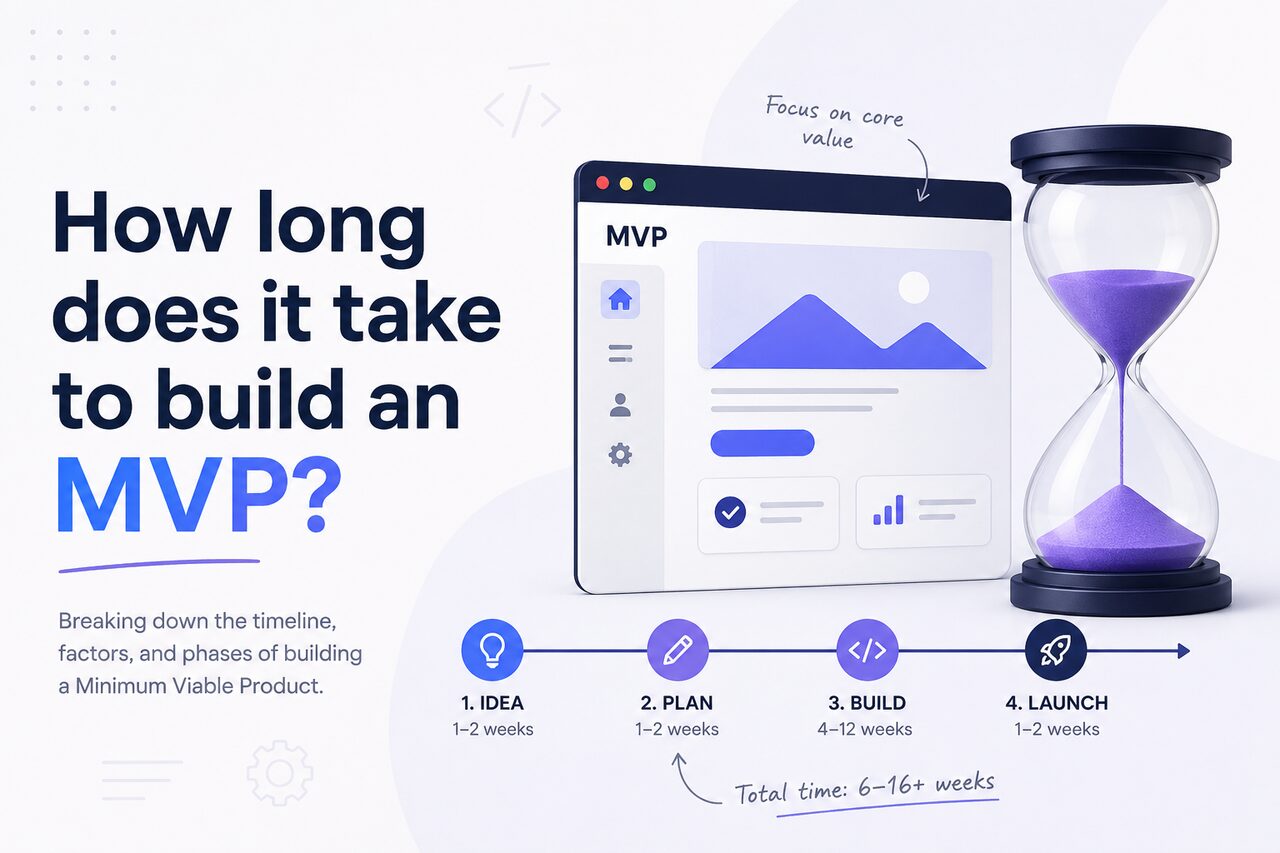
A focused MVP typically takes six to twelve weeks. The spread comes almost entirely from how ruthless you are about scope.
That answer can feel frustrating because founders usually want one clean number. But an MVP is not a fixed object. For one product, the MVP is a landing page, onboarding flow, and one paid booking journey. For another, it is authentication, dashboards, payments, admin tools, notifications, and a reporting layer. Both can be “minimum” relative to the idea, but they are not the same build.
The useful way to estimate an MVP is to identify the riskiest assumption and build the smallest product that can test it with real users.
What an MVP is actually for
An MVP is not the cheap version of the final product. It is a learning tool.
The goal is to find out whether a specific audience will use, value, and maybe pay for a specific solution. That means the MVP needs enough quality to create trust and enough functionality to test the core behavior. It does not need every feature from the long-term vision.
This distinction matters. If the MVP is too rough, users may reject the execution rather than the idea. If it is too large, you spend months building assumptions that should have been tested earlier. The right MVP sits in the middle: narrow, credible, usable, and measurable.
Good MVP scope starts with one sentence: “We need to learn whether this user will do this action for this reason.” Everything else is secondary.
What eats the timeline
Every “small” extra feature adds design, build, and testing time. The fastest MVPs ship one core loop extremely well and defer everything else.
The core loop is the repeated action that makes the product valuable. In a booking product, it might be search, choose, book, and confirm. In a marketplace, it might be create supply, browse demand, match, and transact. In an internal tool, it might be submit request, approve request, and track status.
Timeline expands when the team adds features outside that loop too early: advanced profiles, complex settings, referral systems, dashboards, admin exports, multiple payment models, chat, analytics, custom notifications, and role types that are not needed for the first test.
Third-party integrations also affect timing. Payments, authentication, email delivery, calendar sync, maps, CRMs, and file storage are normal MVP pieces, but each one brings setup, edge cases, testing, and failure states. Integrations are useful when they reduce risk or enable the core loop. They are expensive distractions when added only because the final product might need them someday.
What needs to be ready before development
A faster MVP is usually not rushed. It is prepared.
Before development starts, the founder should know the target user, the problem, the core action, the first offer, and the success metric. The product does not need a 60-page specification, but it does need clear decisions.
Useful preparation includes a short product brief, examples of comparable tools, must-have user roles, the core workflow, any required integrations, brand basics, and launch constraints. If payments are involved, pricing should be decided. If email is involved, the basic messages should be known. If onboarding matters, the minimum information required from a user should be defined.
Unmade decisions slow projects more than difficult code. A developer can help shape the product, but they cannot safely guess the business model, pricing, audience, or legal constraints.
A sane six-to-twelve-week sequence
Week one is discovery and scope. The team clarifies the goal, user types, core workflow, data model, risks, and launch definition. This phase should reduce the product, not inflate it.
The next stage is UX and structure. The product is mapped into screens and states: empty states, loading states, errors, success states, permissions, and admin needs. This is where many hidden requirements appear. It is cheaper to find them in a flow diagram than in production code.
Development should happen in reviewable slices. Instead of disappearing for a month and returning with a surprise, the developer ships usable parts to a live staging link. The founder can click through, give feedback, and catch misunderstandings early.
The final stretch is testing, content, analytics, deployment, and launch support. This includes checking the main workflow on mobile and desktop, testing forms and emails, verifying payments if present, reviewing error states, and making sure the first users can be supported.
Six weeks is possible when scope is narrow and decisions are ready. Twelve weeks is more realistic when the MVP includes several user roles, payments, admin tools, and integrations. Longer than that may still be valid, but it is worth asking whether the first learning milestone can be smaller.
Why faster is not always cheaper
Speed has tradeoffs. You can move quickly by cutting scope, using proven tools, and making decisions promptly. That is good speed. You can also move quickly by skipping design thinking, testing, security, and maintainability. That is borrowed time.
The second kind of speed often becomes expensive after launch. Users hit broken flows. The team cannot manage data. The app is hard to change. The founder needs a rebuild just when the product should be learning from the market.
An MVP does not need enterprise architecture, but it does need enough discipline to survive iteration. Clean foundations matter because the first version is rarely the last version.
What to cut from version one
Cut anything that does not test the riskiest assumption.
You probably do not need advanced analytics before you have users. You may not need a complex admin dashboard if a simple internal view works for the first month. You may not need automated billing if manual invoicing is acceptable for ten beta customers. You may not need every notification channel when email is enough.
Manual operations are not failure in an MVP. They are often smart. If a human can handle a rare process during the first test, automate it later. Spend development budget on the parts users must experience directly.
The question is not “Will we need this one day?” The question is “Do we need this to learn the next important thing?”
What not to cut
Do not cut the core user experience. If the product depends on trust, the interface cannot feel careless. If the product handles money, the payment flow must be clear. If the product stores user data, security and permissions need attention. If users need to complete a task, the path must be understandable.
Do not cut analytics entirely. You need some way to see whether users arrive, activate, complete the key action, and return. The metrics can be simple, but they should exist.
Do not cut feedback channels. Early users should have an easy way to report confusion, bugs, and missing value. Qualitative feedback is often more useful than dashboards in the first weeks.
After launch
The MVP is not finished at launch. Launch is when the real learning starts.
Plan at least one iteration window after the first users try it. Some feedback will be noise. Some will reveal real friction. The founder and developer should separate urgent fixes, usability improvements, and new feature ideas. Not every request deserves immediate development.
The best next version is guided by behavior, not by the original wish list. If users fail during onboarding, fix onboarding. If they complete the core action but do not return, investigate value and reminders. If they ask for the same missing feature repeatedly, that feature may be moving from “later” to “necessary.”
A realistic expectation
For a focused MVP, six to twelve weeks is a healthy planning range. The lower end requires a narrow workflow, ready decisions, few integrations, and fast feedback. The higher end fits more complex products with roles, payments, admin tools, and stronger polish.
The point is not to build everything quickly. The point is to build the smallest credible product that can teach you what to do next. If the MVP answers the right question, it has done its job.
Related reading
Have a project in mind?
Get an honest, fixed quote before any work begins.