Website vs web app: what does your business actually need?
They sound similar and cost very differently. Choosing the wrong one wastes money — here’s how to tell them apart.
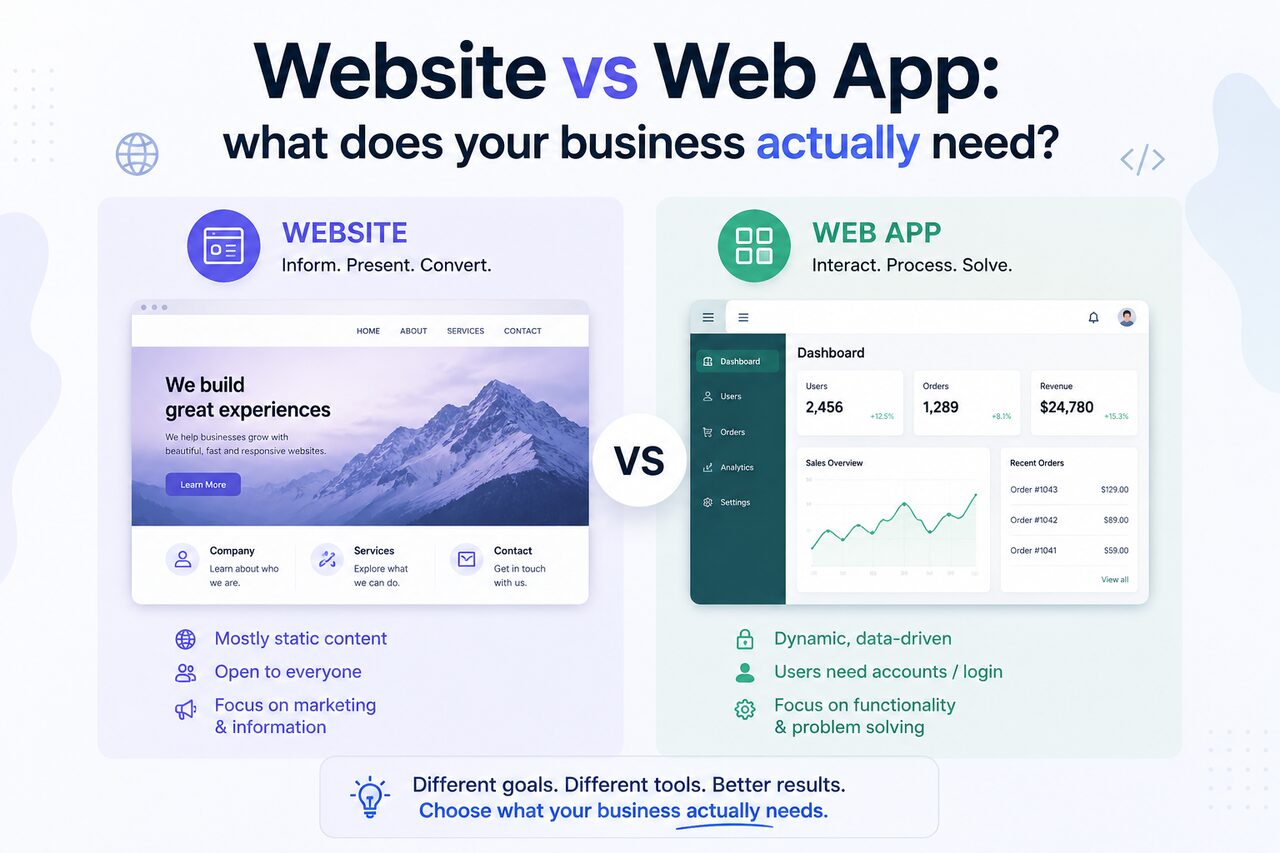
A website presents information; a web app does work. That one distinction saves a lot of confused conversations and mismatched budgets.
The confusion is understandable. Both live in a browser. Both can look polished. Both can have forms, dashboards, and payment buttons. But they solve different business problems and require different levels of planning, design, development, and maintenance.
If you choose too little, the site will not support the workflow you actually need. If you choose too much, you will spend app money on a problem that a focused website could solve. The goal is not to use the more impressive label. The goal is to build the right tool for the job.
You need a website if
You need a website when the primary job is communication. The visitor arrives, learns, compares, trusts, and takes a next step.
That next step might be sending an inquiry, booking a consultation, calling the business, buying a straightforward product, downloading a guide, or reading more before making a decision. The site does not need to manage a complex process. It needs to make the business easy to understand and easy to contact.
This is usually the right choice if you are marketing a service, explaining an offer, presenting case studies, publishing articles, or building credibility around a company. The site can still be custom, fast, and strategically designed. It just does not need application logic behind every screen.
A good website answers the buyer’s questions: What do you do? Who is it for? Why should I trust you? What does it cost? What happens next? What proof can you show? If those questions are unclear, no amount of app functionality will fix the business problem.
You need a web app if
You need a web app when users log in and do something meaningful. They create records, manage data, complete tasks, collaborate, make payments, track status, or run a repeatable workflow.
That usually means the system has user accounts, permissions, dashboards, databases, notifications, validations, admin tools, and error handling. It may connect with payment providers, CRMs, email platforms, maps, calendars, analytics, or internal systems. The design work is not only about presentation. It is about helping people complete tasks accurately.
Common examples include booking platforms, client portals, internal dashboards, marketplace MVPs, SaaS products, quoting tools, inventory systems, learning platforms, and workflow automation tools.
In a web app, the user’s question is not only “Do I trust this company?” It is also “Can I use this product without getting stuck?” That changes the project. The developer needs to think about states, roles, edge cases, security, data structure, and long-term maintenance.
The gray area
Many businesses sit between the two. They need a marketing website with one or two app-like features: a booking form, calculator, quiz, member area, checkout flow, or client upload form.
This does not automatically make the whole project a web app. It may be a website with custom interactive components. That can be the smartest option when the public pages are still the main asset and the functional feature is narrow.
For example, a clinic may need strong service pages and an appointment request flow. A consulting firm may need a public site and a private resource area. A service business may need a pricing calculator that sends a qualified lead. These projects need more engineering than a static site, but less than a full application.
The decision depends on how central the functionality is. If the feature supports the sale, it can often live inside a website. If the feature is the product or the main delivery system, it is probably a web app.
Cost differences
Websites and web apps cost differently because the risk is different.
A website has content, layout, responsive behavior, forms, SEO, performance, and launch concerns. A web app has all of that plus software behavior. Users can take actions. Data can be wrong. Permissions can fail. Payments can break. Notifications can be missed. Admin screens can create operational problems if they are unclear.
That is why a professional website may start around a few thousand euros, while a custom app or MVP starts higher. You are paying for the design and build of a system, not just pages.
The cost difference continues after launch. A website needs updates, security care, and content work. A web app needs monitoring, bug fixes, dependency updates, feature improvements, database backups, user support, and sometimes infrastructure planning. If the app becomes part of the business, maintenance is not optional.
Search and marketing differences
A website is usually stronger for visibility because public content can be indexed, shared, and structured around search intent. Service pages, case studies, articles, pricing explanations, and comparison pages all help people discover the business.
A web app often has much of its value behind login. Search engines cannot see private dashboards or user-specific workflows. That does not make an app bad. It means the app usually still needs a public marketing site around it.
This is a common mistake for startups. They spend most of the budget on the product interface and leave the public website vague. Then potential users do not understand the product, investors cannot quickly see the story, and early customers do not know why they should sign up.
Even when you build a web app, you still need clear public pages that explain the problem, audience, value, pricing, trust signals, and next step.
Operational differences
A website is mostly managed through content. You add pages, edit text, publish articles, update case studies, and improve conversion paths.
A web app is managed through product decisions. You prioritize features, handle bugs, watch user behavior, improve onboarding, support accounts, and protect data. The work does not end at launch because real users reveal what the product needs next.
That means the client’s role is different too. For a website, the client needs to provide content, approvals, brand direction, and business context. For an app, the client also needs to define workflows, user roles, data rules, edge cases, and product priorities.
If those operational details are not ready, the app can stall. The developer cannot invent the business process from nothing. They can help shape it, but the knowledge has to come from the people who understand the work.
How to choose
Start with the primary user action.
If the visitor mostly reads, evaluates, and contacts you, build a website. If the user logs in and completes work repeatedly, build a web app. If the public pages drive demand and one feature supports qualification or booking, build a website with a focused custom component.
Then ask what happens after launch. Will the business mainly publish and refine content? Or will it operate a product with users, accounts, data, and support? The answer points to the right investment level.
Also ask what can be done in phases. Many businesses should start with a strong website, prove demand, and then add app functionality. Others already have a manual process that is painful enough to justify a custom portal or internal system now.
Build foundations that do not trap you
The safest path is to build the first version on foundations that allow growth. A website should have clean structure, fast performance, sensible content management, and room for future integrations. A web app should have a clear data model, secure authentication, maintainable code, and a focused first scope.
The expensive mistake is not choosing website or app. The expensive mistake is building something that cannot evolve.
If your business needs visibility, trust, and inquiries, a website is probably the right first move. If your business needs users to run a workflow, manage data, or use a product, you are in web app territory. If you need both, separate the marketing job from the product job and fund each one honestly.
Related reading
Have a project in mind?
Get an honest, fixed quote before any work begins.