Ecommerce website development: decisions that shape cost and growth
A good online store is not only a product grid. Platform choice, content, checkout, integrations, and operations shape the real project.
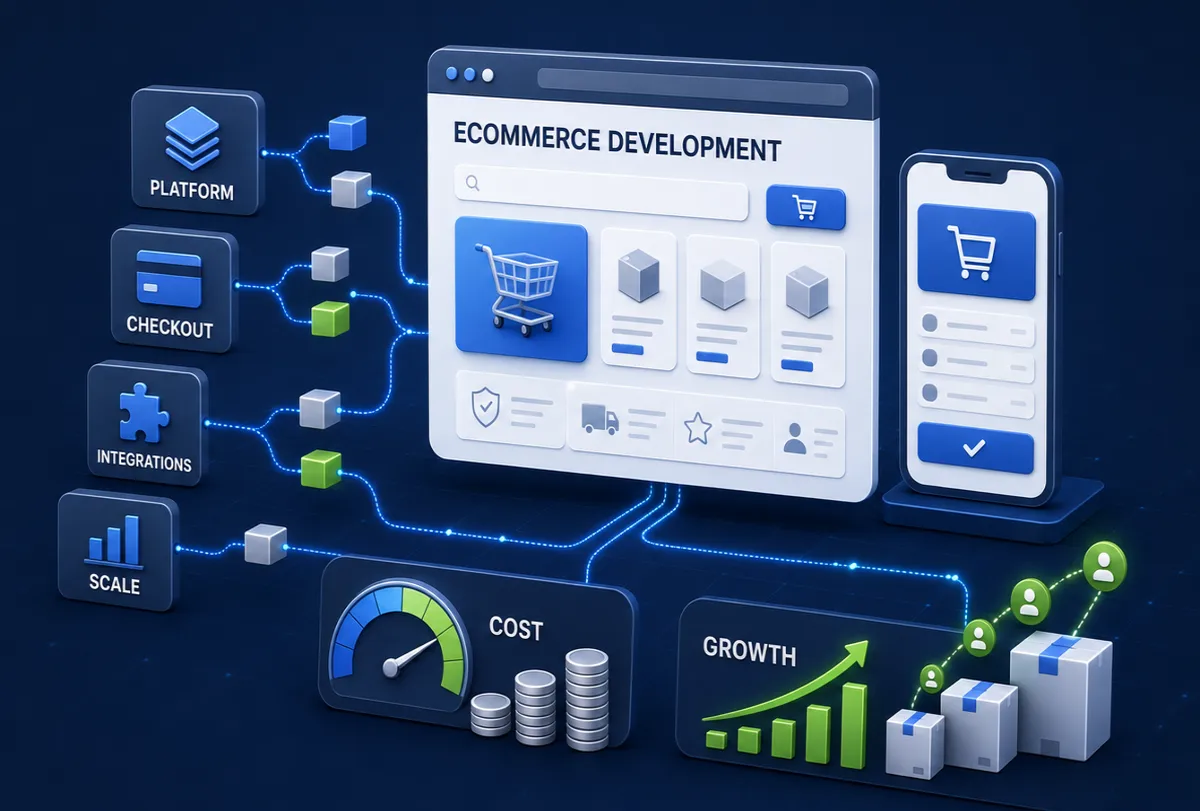
Ecommerce website development becomes expensive when everyone treats the store as a visual project until the week before launch. The homepage looks good. Product cards look good. Then the real questions arrive: how do variants work, what happens when stock is low, how is shipping calculated, who edits product data, what taxes apply, what emails are sent, how are returns handled, and which systems need to sync?
An online store is a sales channel and an operations system. The earlier you make the operational decisions, the cleaner the build becomes.
For small businesses, the goal is not to build the most complex store possible. It is to launch a reliable buying experience that customers trust and the team can manage without daily developer help.
Platform choice is a business decision
The first big decision is whether to use a proven ecommerce platform, extend a CMS, or build a custom storefront and backend. Most small businesses should start with proven infrastructure unless the selling model is genuinely unusual.
Standard products, simple inventory, normal discounts, ordinary shipping, and familiar checkout flows usually fit existing platforms well. The business gets payments, admin tools, order emails, product management, and basic security without funding every piece from scratch.
Custom development makes sense when the commerce model is the advantage: complex subscriptions, unusual bundles, custom pricing, marketplace logic, B2B ordering, gated catalogs, integrations with internal systems, or product configuration that standard tools cannot handle cleanly.
This is the same build-versus-buy logic covered in custom software vs SaaS. Use standard tools for standard problems. Build where the workflow creates real value.
Product data quality shapes everything
A store is only as good as its product data. Names, descriptions, images, variants, prices, stock rules, categories, filters, shipping attributes, SEO fields, and related products all affect the customer experience.
Poor product data creates expensive design problems. If product names are inconsistent, cards look messy. If images have different proportions, grids feel unstable. If variants are unclear, customers hesitate. If descriptions are thin, search visibility suffers. If categories are improvised, navigation becomes confusing.
Before development starts, prepare a sample product set that represents the real catalog. Include the simple products and the difficult ones. A developer can design a better structure when they see the actual complexity instead of a perfect demo product.
For larger catalogs, content modeling matters as much as page design. The CMS or ecommerce admin should make good entries easy and bad entries harder.
Checkout must feel boring
Checkout is not the place for creative surprises. Customers want to know what they are buying, what it costs, how it will be delivered, how they can pay, and what happens next.
Every unnecessary field, unclear fee, late shipping surprise, weak error message, or slow interaction can reduce completion. On mobile, the effect is stronger because attention is shorter and typing is more annoying.
A serious ecommerce build tests checkout on real devices. It checks payment success, payment failure, validation errors, abandoned steps, confirmation emails, order records, inventory updates, and admin notifications. If discounts, taxes, gift cards, subscriptions, or pickup options exist, they need testing too.
This is where ecommerce becomes application development. A store may look like a website, but the moment money, accounts, orders, and business rules are involved, software quality matters.
Shipping and tax decisions cannot wait
Shipping and tax rules are not details to fill in at the end. They affect checkout, product pages, cart behavior, customer support, and sometimes legal compliance.
Does the business ship locally, nationally, or internationally? Are there free shipping thresholds? Are some products oversized, fragile, digital, refrigerated, or pickup-only? Are taxes included in displayed prices or added later? Are invoices needed? Are B2B customers handled differently?
Unclear answers create scope drift. Developers can integrate carriers, configure rules, or build custom logic, but they cannot safely invent commercial policy. The business owner needs to decide how selling actually works.
If those rules are still changing, keep the first version simpler. It is better to launch a reliable limited store than a complex checkout that nobody trusts.
SEO starts with store structure
Ecommerce SEO is not only metadata. Category structure, product URLs, filters, canonical behavior, internal links, page speed, image alt text, structured data, and content depth all matter.
Faceted navigation can create thousands of low-value URLs if filters are crawlable without control. Product variants can create duplicate content if every color or size has its own weak page. Out-of-stock products need a policy: keep, redirect, suggest alternatives, or remove depending on demand and replacement availability.
Search visibility also depends on useful category pages. A category page with only a grid may be thin. Add buying guidance, FAQs where appropriate, internal links, and copy that helps customers choose without burying the products.
The technical SEO implementation checklist covers the underlying implementation issues that often decide whether ecommerce pages are discovered and understood correctly.
Performance is part of merchandising
Stores are image-heavy by nature. That makes performance a business issue. Slow product images, layout shifts in grids, heavy recommendation widgets, and overloaded tracking scripts can make browsing feel clumsy.
Performance work should focus on the actual buying journey: homepage, category, product detail, cart, checkout, and account screens if they exist. Images need responsive sizes and modern formats. Product grids need stable dimensions. Third-party scripts need ownership. Search and filters need to respond quickly.
The article on Core Web Vitals explains why loading, responsiveness, and visual stability affect leads. For ecommerce, they affect product discovery and checkout confidence.
Integrations define the hidden scope
Many ecommerce projects depend on systems outside the storefront: payment providers, shipping carriers, accounting software, inventory systems, email marketing, CRM, ERP, analytics, review platforms, fulfillment tools, and customer support.
Each integration adds edge cases. What happens if payment succeeds but order sync fails? What happens if the shipping API is unavailable? Which system is the source of truth for stock? How are refunds handled? Who receives alerts when something breaks?
These questions should be listed during scope, not discovered after launch. Integrations are often worth it, but they need clear ownership and failure behavior.
For stores with unusual operational workflows, a client portal or internal dashboard may eventually become useful. Do not add it to version one unless it solves repeated operational pain.
Growth requires maintainability
The first version of a store is rarely the final version. Products change, campaigns run, categories shift, content expands, and analytics reveal friction. That means maintainability matters from day one.
Business owners should be able to edit products, publish content, update basic SEO fields, manage orders, and review customer messages without breaking layouts. Developers should be able to update dependencies, add features, and debug issues without fighting a pile of undocumented plugins.
If the store is already old, slow, or hard to change, read legacy website and app modernization before deciding whether to patch or rebuild.
A good store feels operationally calm
Good ecommerce development does not end at a beautiful product grid. It creates a store that customers can use and the business can operate.
The right platform fits the model. Product data is structured. Checkout is predictable. Shipping and taxes are clear. SEO foundations are clean. Performance supports browsing. Integrations are understood. Admin workflows match real staff behavior.
That is the difference between launching a store and launching a sales channel.
Have a project in mind?
Get an honest, fixed quote before any work begins.