When SEO agencies need a development partner, not another plugin
SEO recommendations only create value when they reach production cleanly. Here is how agencies can choose the right development support.
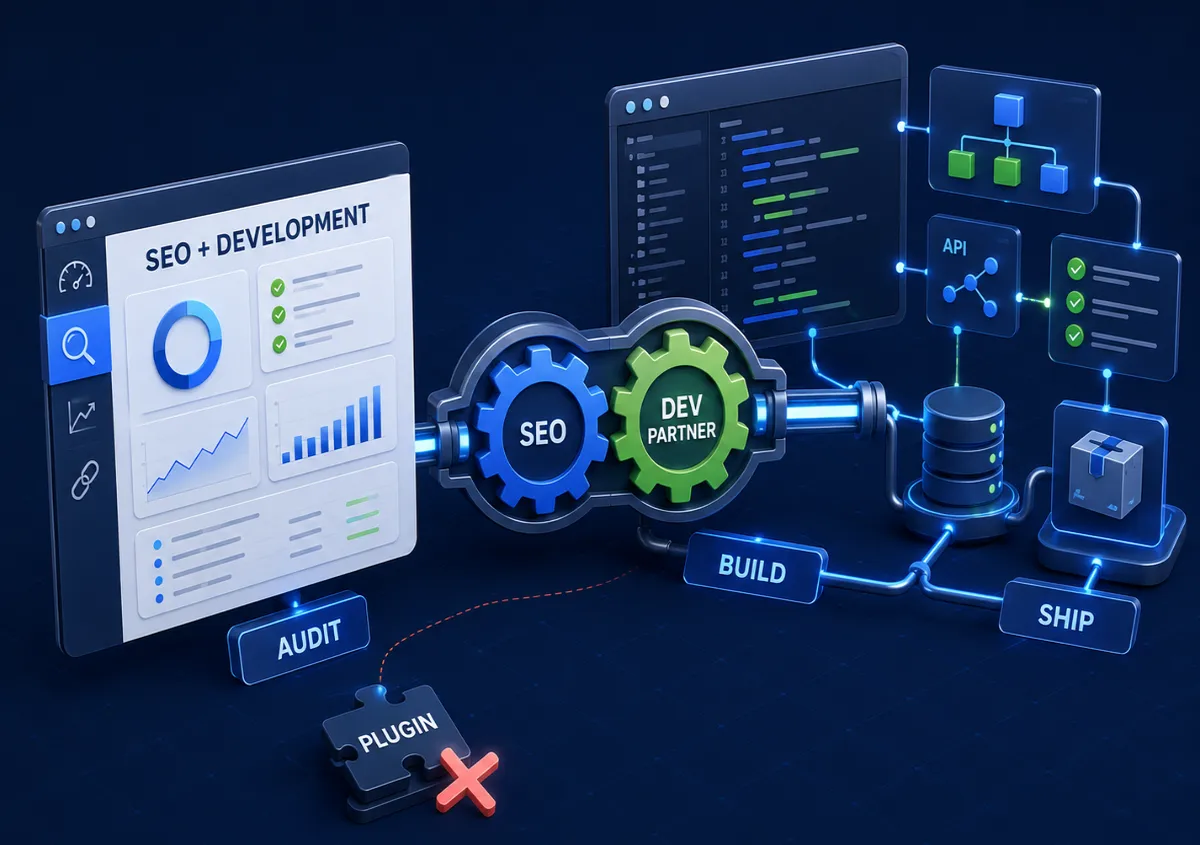
SEO agencies do not usually lose momentum because they lack ideas. They lose momentum because recommendations sit in a backlog, get implemented halfway, or break something when they finally reach production.
The audit is done. The opportunities are clear. The client agrees that titles, redirects, structured data, internal links, page speed, templates, or indexation need work. Then everyone discovers the difficult part: the website is custom, the CMS is fragile, the original developer is unavailable, the theme is overloaded, or the client's internal team has no capacity.
At that point, another plugin is rarely the answer. The agency needs a development partner who can turn SEO direction into reliable code.
Strategy without implementation is shelfware
An SEO strategy has no commercial value until it changes the live website. A perfect spreadsheet of fixes does not improve crawlability. A beautifully prioritized content map does not create internal links by itself. A Core Web Vitals diagnosis does not reduce JavaScript. A schema recommendation does not validate in production unless someone implements and tests it.
This gap is common because SEO and development use different operating rhythms. Agencies think in campaigns, audits, rankings, content plans, and reports. Developers think in codebases, deployment risk, dependencies, data models, and regressions. The client just wants the site to bring more qualified business.
A good partner respects both sides. They understand why the SEO task matters and what could go wrong when changing the site.
The work is often more than "small fixes"
Many SEO tickets sound small because the visible change is small. Add canonical tags. Fix duplicate titles. Generate a sitemap. Improve image alt text. Add breadcrumbs. Change heading structure. Redirect old URLs. Lazy-load images. Remove render-blocking scripts.
In a clean codebase, some of these are straightforward. In a real client site, they may touch routing, content models, build tools, plugins, server responses, localization, analytics, design components, and deployment configuration.
For example, adding schema to one page is easy. Adding accurate schema to every article, service page, product, and breadcrumb trail through a CMS is a system change. Fixing one oversized image is easy. Creating an image pipeline that prevents future oversized uploads is more valuable. Redirecting one page is easy. Preserving hundreds of old URLs during a redesign is operational work.
That is why the technical SEO implementation checklist treats SEO as production engineering, not a list of tags.
Plugins help until they hide the problem
Plugins can be useful. A good CMS SEO plugin can expose metadata fields, generate sitemaps, and make common settings easier to manage. The problem starts when plugins become a substitute for understanding.
If a site has five plugins fighting over metadata, the output can become inconsistent. If a performance plugin defers JavaScript blindly, it can break menus, forms, tracking, or checkout. If a schema plugin adds markup that does not match visible content, it creates risk. If a redirect plugin stores critical launch behavior in a database nobody exports, migration becomes harder later.
The right developer does not reject plugins automatically. They decide which concerns belong in code, which belong in the CMS, and which belong in a proven third-party tool. That judgment is especially important on ecommerce sites, multilingual sites, and web apps with public landing pages.
Performance needs careful hands
Core Web Vitals work is a common point of tension between agencies and developers. The agency sees poor scores and knows they affect user experience. The developer sees a site full of dependencies, tracking scripts, heavy assets, and design decisions that were approved months ago.
Improvement requires prioritization. Which pages matter most? Is the LCP element an image, heading, or video? Is INP poor because of long JavaScript tasks? Is CLS caused by fonts, ads, embeds, images without dimensions, or late-loading components? Which scripts are required for revenue attribution, and which are legacy clutter?
The article on Core Web Vitals and leads explains why these questions belong in commercial planning. For agencies, the practical takeaway is this: performance work should be implemented in measurable slices, with before-and-after evidence and regression checks.
Redesigns need redirect discipline
SEO agencies are often pulled into redesigns after the visual direction is already approved. That is late. The highest-risk SEO decisions happen during structure planning: which pages stay, which merge, which split, which URLs change, and which content should be strengthened before launch.
A development partner can help protect that work. They can crawl the old site, map redirects, preserve metadata where appropriate, generate new routes, test status codes, update internal links, and confirm that the sitemap reflects the new canonical structure.
Without that discipline, a redesign can look better and perform worse. Traffic drops, indexed pages disappear, old backlinks land on weak redirects, and the client blames SEO even though the implementation caused the damage.
For client education, website redesign checklist is a useful companion article.
Agencies need clear technical communication
A good development partner does not force the agency to translate everything into engineering language. They can take an SEO recommendation and ask the missing implementation questions.
Which page types are affected? Should this be editable in the CMS? Does it apply to every locale? Is the priority mobile performance, crawlability, conversion, or reporting accuracy? Should redirects be permanent? What analytics events need preservation? Is the staging environment index-blocked? Who approves changes before deployment?
Clear communication also protects the agency-client relationship. The client should not hear "the developer says no" without context. They should hear what is possible, what is risky, what is faster, what requires deeper refactoring, and what order makes commercial sense.
This is the same evaluation logic businesses can use when they hire a senior freelance developer.
The best partnership model
The best model is usually ongoing but lightweight. The agency keeps strategy, content, reporting, and client direction. The developer handles implementation planning, code changes, technical QA, deployment, and maintainability. Both sides agree on a simple intake process and a shared definition of done.
For small fixes, that definition may be a deployed change, tested on mobile and desktop, with screenshots or validation links. For larger work, it may include staging review, redirect maps, metadata exports, schema validation, performance comparison, and post-launch checks.
This model is especially useful for agencies that serve small businesses. Their clients often need the same mix: better service pages, faster sites, cleaner technical foundations, and practical conversion improvements. The agency can sell the outcome without pretending every implementation detail is in-house.
What to look for in a partner
Look for a developer who can work across frontend, backend, CMS, hosting, and analytics without treating SEO as an annoyance. They should understand HTML output, rendering, metadata, structured data, redirects, performance, accessibility, and deployment risk. They should be comfortable reading an audit, challenging unclear tickets, and explaining tradeoffs without drama.
They should also know when not to build. Sometimes the right answer is a CMS setting, a plugin configuration, a content change, or a smaller scope. That judgment matters because agencies need margin and clients need results, not engineering theater.
If your agency repeatedly finds good recommendations stuck in development limbo, the bottleneck is not another report. It is implementation capacity. Fix that, and your SEO work has a much better chance of becoming visible in the real world.
Have a project in mind?
Get an honest, fixed quote before any work begins.