How to evaluate a senior freelance developer before you hire
A senior freelance developer should reduce uncertainty, explain tradeoffs, and protect the project from avoidable technical and delivery risk.
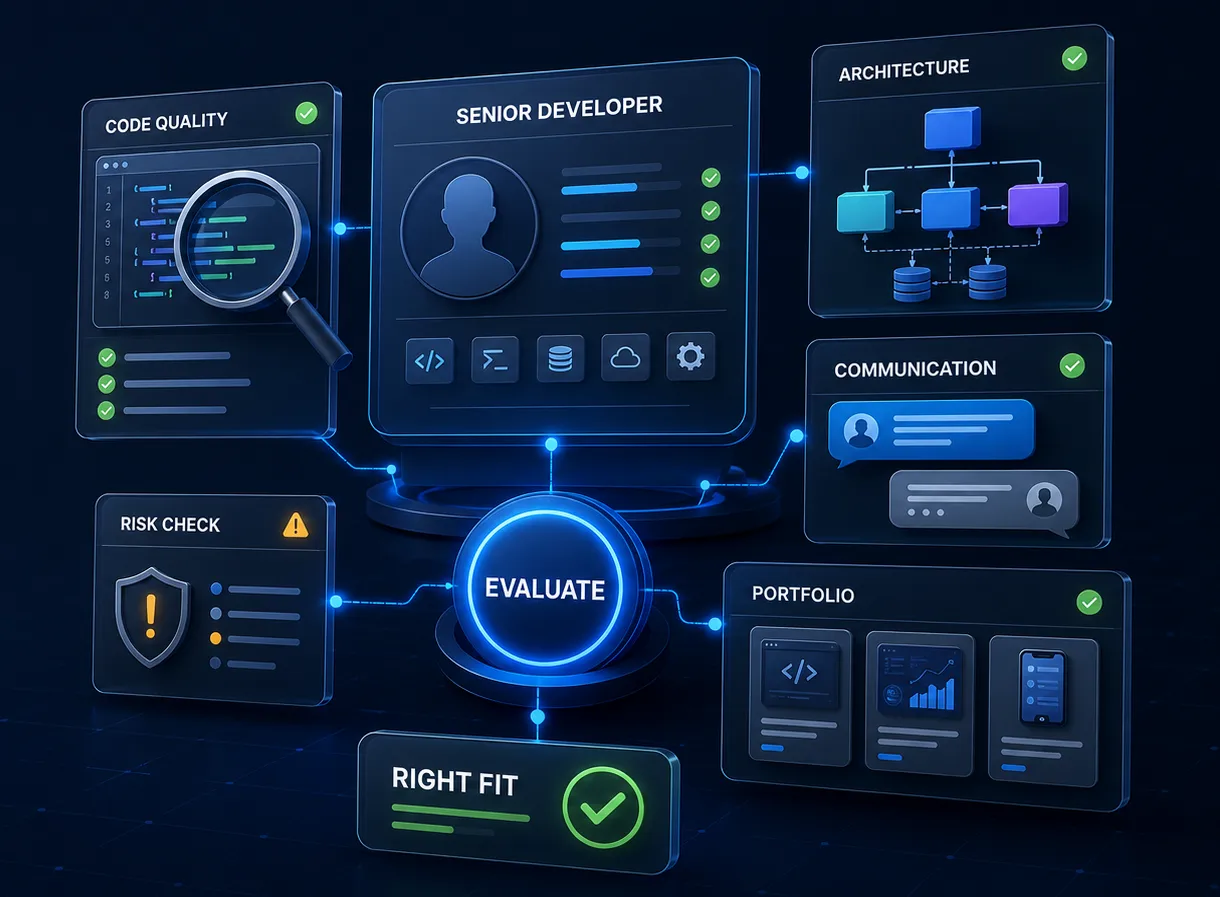
Hiring a senior freelance developer is not the same as buying a set of coding hours. You are choosing someone who will make technical decisions on behalf of the business, often with limited oversight and real consequences for budget, launch timing, security, performance, and maintainability.
The right person reduces uncertainty. The wrong person creates a project that looks finished until it needs to change.
This matters for small businesses, startups, SEO agencies, and companies hiring contract or permanent engineering help. A senior developer should be able to understand the goal, shape the scope, communicate tradeoffs, and build in a way another competent developer can later understand.
Look for problem framing
A senior developer should not begin by prescribing technology before understanding the problem. If the first answer to every request is a framework, app, plugin, or rebuild, be careful.
Good framing sounds different. What is the business goal? Who uses this? What has to happen for the project to be successful? What constraints matter: budget, deadline, compliance, SEO, integrations, internal team skills, content readiness, or maintenance capacity?
For a simple marketing website, the right solution may be a lean CMS-backed site. For a startup MVP, it may be a narrow product that tests one core behavior. For an operations problem, it may be a client portal or internal dashboard. For some workflows, it may be better to use SaaS and only build the custom layer that creates leverage.
The article on custom software vs SaaS is a useful test of this thinking.
Ask how they handle scope
Scope control is one of the clearest signs of seniority. A developer who accepts every idea without prioritization may feel agreeable early and become expensive later.
Ask what belongs in version one and what should wait. Ask what assumptions are risky. Ask what can be handled manually during launch. Ask what would make the timeline longer. Ask where fixed price is appropriate and where hourly discovery makes more sense.
For founders, this is critical. A good MVP is not a smaller version of the final product. It is a focused learning tool. A senior developer should be comfortable cutting features when they do not support the first learning milestone. The MVP timeline guide explains why scope discipline affects both speed and cost.
Review communication quality
Senior freelance work depends on written communication. The developer may not sit inside your company. They need to make progress without constant meetings and still keep you informed.
Look at how they explain tradeoffs. Do they translate technical risk into business language? Do they clarify assumptions? Do they tell you what they need before development starts? Do they make decisions visible before those decisions become expensive?
Poor communication often appears as vague confidence. "No problem, we can do everything" is less useful than "Yes, but payments, account roles, and admin workflows make this an application project, so we should define the first release carefully."
The existing article on what to prepare before hiring a web developer can help you bring better inputs to that conversation.
Inspect their attitude toward maintenance
A project is not successful only because it launches. It also needs to be understandable, updateable, secure, and reasonably easy to extend.
Ask how they structure content, manage dependencies, handle environment variables, test forms, optimize images, deploy changes, and document handover. Ask what happens after launch if a dependency breaks, a CMS editor needs a new field, or an analytics script changes.
For startups, maintainability affects product iteration. For SEO agencies, it affects whether future recommendations can be implemented quickly. For small businesses, it affects whether the site becomes a dependable asset instead of a black box.
A senior developer does not need to over-engineer a small site. They do need to leave it in a condition that can be maintained.
Check technical SEO awareness
Even if you are not hiring specifically for SEO, a web developer should understand the basics: crawlable content, unique metadata, headings, redirects, canonical URLs, sitemaps, structured data, image performance, and accessible HTML.
This matters because many website projects are also visibility projects. A beautiful site that search engines cannot understand, that loses old URLs, or that loads slowly on mobile is not finished.
If an SEO agency is involved, the developer should be able to read an audit and implement the recommendations safely. The technical SEO implementation checklist and SEO agency partner articles cover this in more detail.
Ask about performance from the start
Performance is a good proxy for technical care. A senior developer should have practical opinions about image formats, responsive sizing, font loading, JavaScript weight, caching, third-party scripts, and layout stability.
They do not need to promise perfect scores. They should be able to explain what affects speed and how they measure it. They should know the difference between lab tools and real-user field data. They should understand why a hero image, booking widget, ecommerce filter, or analytics stack can affect the user experience.
The Core Web Vitals article gives business owners a useful vocabulary for this conversation.
Look for evidence, not only aesthetics
Portfolios matter, but screenshots are not enough. Ask what problem the project solved, what constraints existed, what tradeoffs were made, what the developer personally handled, and what happened after launch.
For public-sector or regulated work, ask about accessibility, design system compliance, documentation, and review processes. A developer who can follow strict design system rules is often more valuable than one who only creates visually novel pages. The article on government design system websites explains why precision matters in that context.
For ecommerce, ask about checkout, product data, integrations, and admin workflows. For custom apps, ask about roles, permissions, security, testing, and deployment.
Be careful with bargain certainty
Cheap certainty is attractive. A developer who promises a low price, short timeline, unlimited revisions, and every feature can feel easier to hire. But software projects punish vague optimism.
This does not mean expensive is automatically better. It means the proposal should show understanding. A strong quote explains scope, assumptions, deliverables, timeline, responsibilities, exclusions, and change process. It gives you a basis for trust beyond personality.
If the business needs a predictable budget, fixed scope is often healthier than open-ended promises. If the product is undefined, a discovery phase may be more honest than pretending the whole app can be priced safely upfront.
The best signal
The best signal is whether the developer improves the quality of your thinking before you sign.
After one or two conversations, you should understand the project more clearly. You should know the risks, the likely phases, what to prepare, and which decisions affect cost. You should feel that the developer is protecting the outcome, not just accepting tasks.
That is what senior help is for. Code matters, but judgment is what you are really hiring.
Have a project in mind?
Get an honest, fixed quote before any work begins.